

What Should You Store in a Hazardous Cupboard?
Many workplaces use chemicals and other hazardous substances as part of their everyday operations. From cleaning products and laboratory chemicals to paints, solvents and other substances, these materials need to be stored carefully when they are not being used.
A hazardous cupboard provides a dedicated place to keep hazardous substances secure, organised and contained. But what exactly should you store in one? And are there substances that should be kept separately?
Understanding what belongs in a hazardous cupboard can help businesses reduce the risks associated with spills, leaks, accidental exposure and inappropriate storage.
What is a hazardous cupboard?
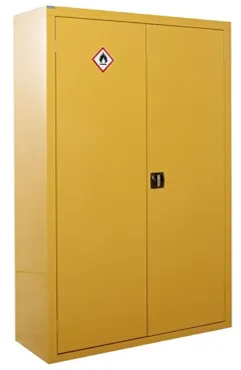
A hazardous cupboard is a dedicated storage unit designed for workplaces that need to store hazardous substances safely. Depending on the type of cupboard, features can include lockable doors, adjustable shelves and spill-containment sumps.
The exact storage requirements will depend on the substances being stored. Employers should always consider the information provided on product labels and Safety Data Sheets, alongside the findings of their COSHH assessment.
A hazardous cupboard should form part of a wider workplace safety system rather than being viewed as a replacement for appropriate risk assessments and procedures.
What can be stored in a hazardous cupboard?
There are many types of hazardous substances that may require dedicated storage. However, the correct storage solution will depend on the properties and hazards associated with each substance.
Cleaning chemicals
Commercial cleaning products can contain substances that may cause irritation, burns or other health effects if they are incorrectly handled.
Where appropriate, cleaning chemicals can be kept in a dedicated hazardous cupboard when they are not in use. Containers should remain clearly labelled and securely closed.
Paints and solvents
Paints, thinners, adhesives and solvents are commonly found in workshops, maintenance areas and manufacturing environments.
Some of these products may present additional hazards, such as flammability. This means they should not simply be placed together without checking their individual storage requirements. Always refer to the manufacturer's instructions and Safety Data Sheet.
Laboratory and industrial chemicals
Schools, laboratories, manufacturing facilities and other industrial workplaces may use a wide range of chemicals.
Acids, alkalis and other corrosive substances may require dedicated storage, but incompatible substances should not necessarily be stored together. Chemical compatibility is an important consideration when deciding how and where products should be stored.
Maintenance and workshop chemicals
Workshops may use products such as degreasers, cleaning agents, lubricants and other chemical products.
Keeping these materials in a designated storage cupboard can help prevent containers from being left around work areas where they could be knocked over or accessed unnecessarily.
Not all hazardous substances should be stored together
One of the most important things to remember is that a hazardous cupboard does not mean that every hazardous substance can safely be stored in the same place.
Some chemicals can react with one another if they come into contact. For example, incompatible substances may need to be physically separated to reduce the risk of a dangerous reaction following a leak or spill.
Before storing chemicals together, check their Safety Data Sheets and your workplace COSHH assessment. HSE guidance recommends considering the compatibility of substances when planning storage arrangements.
What shouldn't be stored in a hazardous cupboard?
The answer depends on the type of cupboard and the substances involved.
For example, highly flammable substances may require a purpose-designed flammable liquids storage cabinet, rather than a general hazardous cupboard. Similarly, certain substances may have specific requirements relating to ventilation, temperature, segregation or fire protection.
You should also avoid using hazardous storage as a place for general workplace items. Keeping unrelated equipment, rubbish or non-chemical materials inside the cupboard can reduce the available storage space and make it harder to identify and manage the substances being stored.
Always follow the manufacturer's storage instructions and the requirements identified by your risk assessment.
How should chemicals be stored?
Once you've established which substances need dedicated storage, good organisation is essential.
Keep containers:
- Clearly labelled and identifiable
- Securely closed when not in use
- Upright and stable
- Free from visible damage or leaks
- Stored according to their compatibility requirements
- Accessible without excessive handling
It's also good practice to regularly review your chemical stock. Remove substances that are no longer required through the appropriate disposal process rather than allowing them to accumulate indefinitely.
Choosing a hazardous cupboard
The right hazardous cupboard will depend on the substances you need to store, the quantities involved and the available space in your workplace.
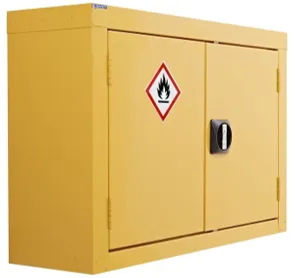
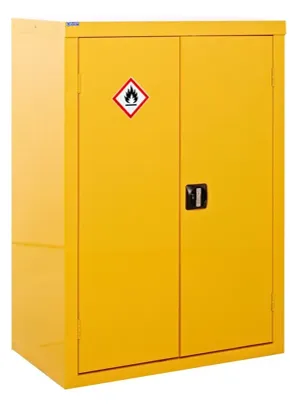
Lockers Online stocks a range of QMP hazardous cupboards, including different sizes and configurations designed to suit a variety of workplace environments. Options include standard, small, low, extra-wide, wall-mounted and mobile hazardous cupboards.
Some models also feature integrated sumps to help contain spills, with different sump capacities available depending on the model.
Before choosing a cupboard, consider what you are storing, how much you need to store and whether any substances require specialist storage arrangements.
Safe storage starts with understanding the risks
A hazardous cupboard can provide an organised and secure location for hazardous substances, but choosing the right cupboard is only part of effective chemical management.
Always check product labels and Safety Data Sheets, follow your COSHH procedures and make sure employees understand how hazardous substances should be stored and handled.
If you're looking for dedicated storage for hazardous substances, explore the QMP Hazardous Cupboards available from Lockers Online to find a solution suited to your workplace.
More Posts:
Get In Touch:
Call for Enquiries
Email us
Unlock the potential of your space with premium locker and storage solutions
Choose Lockersonline.co.uk
Delivery – We try to keep it Simple
Most of our products are delivered free of charge so the price you see advertised include delivery, all you need to do is add the VAT.
Delivery is direct from the factory and is provided as a non scheduled service. Once your order has been placed we will update you with a delivery schedule based on a week commencing date. You will receive your order within that week during normal working hours, Monday to Friday only.
Delivery is direct from the factory and is provided as a non scheduled service. Once your order has been placed we will update you with a delivery schedule based on a week commencing date. You will receive your order within that week during normal working hours, Monday to Friday only.
Please note that we are unable to provide a specific date and time for deliveries.
Most of our locker products are manufactured to order and as such the guideline delivery times for the products are detailed below. This can vary at our busiest times. Please call for current approximated product delivery times. All working days.
Express locker: 5, 10 and 15 day delivery options (subject to quantity)
Standard steel Lockers approx 10 – 20 days
Timber effect lockers 15 – 25 days
Personnel Effects Lockers 12 – 20 days
Compartment Lockers 10 – 20 days
Security lockers 10 – 20 days
High Capacity lockers 10 – 20 days
Clean and dirty locker 10 – 20 days
PPE Lockers 10 – 20 days
Wire Mesh Lockers 10 – 30 days
Lockers available as Nests 10 – 20 days
Solid Grade Laminate Door Lockers 15 – 25 days
School Lockers 10 – 20 days
Laptop Lockers 15 – 25 days
Plastic Lockers 20 – 40 days
Waterproof Lockers 15 – 25 days
Outdoor lockers 20 – 40 days
Sports lockers 10 – 20 days
Golf lockers 10 – 15 days
Slim Line Lockers 10 – 20 days
Garment dispensing lockers 10 – 20 days
Power Tool Re-Charge Lockers 15 – 25 days
Mobile Phone Storage 10 – 25 days
Cloakroom Equipment 10 – 25 days
Cupboards 10 – 20
Cabinets 10 – 20 days
Deliveries to Ireland
If your delivery is required to Ireland please call us in advance of placing any order as we have additional charges.
Please call in advance of placing an order to confirm delivery charges and to arrange payment which is based on the order value and delivery location.
Deliveries to residential Properties.
Please note the non scheduled service we provide detailed above and that we are unable to provide a specific date and time for deliveries.
If there is no one at the delivery address to receive the order we will not be able to leave the goods. If you give us confirmation to do so it must be in writing and in advance of the delivery and will also be at your own risk with Lockersonline accepting no responsibility for the security, safety and state of the products left
If we have to re-deliver due to a failed delivery
If we have been unable to deliver your ordered products and the reason for the failed delivery has not been the fault of Lockersonline then a re-delivery charge of 5% of the net value of the goods with a minimum charge of £25 will be required to be paid by the customer

Are you in need of secure and reliable locker solutions for your business or organisation? Look no further!
At Lockersonline.co.uk our expert team is here to offer top-notch locker options tailored to your unique requirements. Whether it’s for schools, gyms, offices, or any other setting, our extensive range of lockers guarantees unmatched quality and durability. From selecting the perfect locker design to seamless installation, we handle it all, ensuring a hassle-free experience for you. Don’t miss out on the opportunity to elevate your storage solutions.
Take the first step today by completing our “Request a free quote” submission form. Let us understand your needs and provide you with a personalised quote that perfectly fits your budget and timeline.
Secure your belongings with confidence – submit the form now and unlock a world of locker excellence!