


Locker Configurator
Choosing a locker can be a daunting task, so here is our guide to help you make your Locker choice and explain some of the terminology.
Locker Material
- Lockers are built from a range of different materials
- Consider your locker environment and usage needs
Steel
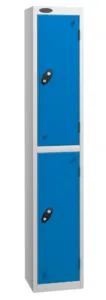
Aluminium
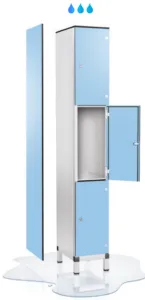
Plastic
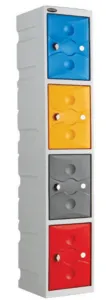
18mm MDF
Core Laminated Doors
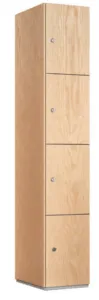
10mm SGL
Solid Grade Laminate
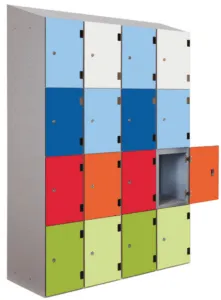
Doors & Compartments
Lockers are normally referenced as a column unit, with one or more doors within that column. For example: One Door Locker, Two Door Locker, Three Door Locker, Four Door Locker etc.
The number of doors indicates the number of internal compartments.
1 Door Locker
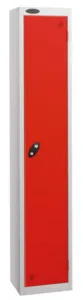
1 Compartment
2 Door Locker
2 Compartment
3 Door Locker
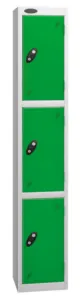
3 Compartment
4 Door Locker
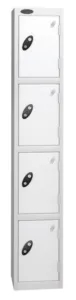
4 Compartment
Nests
Some lockers are available to buy as nests. Here are some examples of how these can be configured.
Lockers are available in a range of sizes. Please ensure that the locker height, width, and depth are suitable for the purpose you require.
1 Door Locker
Single
1 Door Locker
Nest of 2
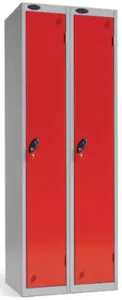
1 Door Locker
Nest of 3
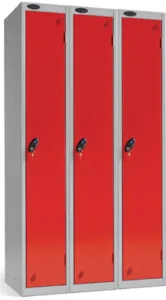
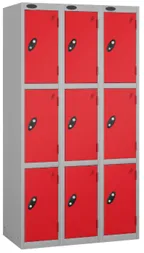
3 Door Locker
Nest of 3
(9 compartments)
Consider adding
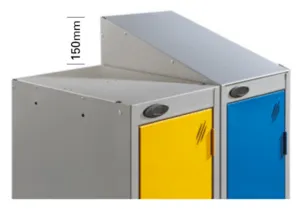
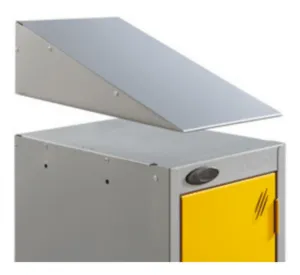
Sloping Tops
- Aesthetically pleasing
- Easier cleaning
- Prevents the accumulation of rubbish
- Adds 150mm height to the locker
Integral sloping top
Retro fit sloping top
Consider adding
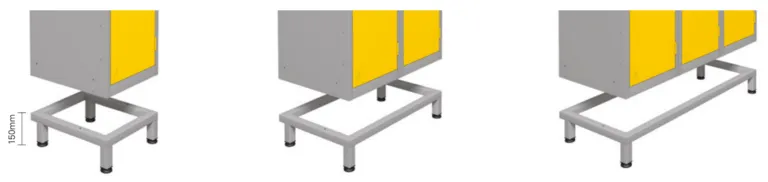
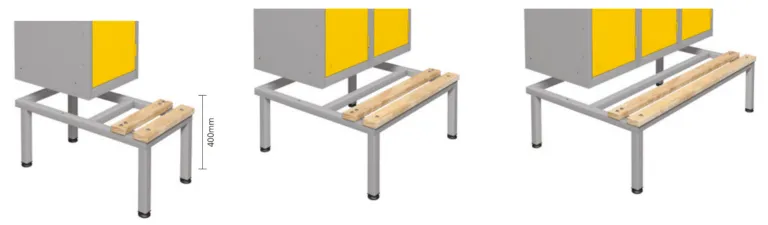
Stands
- Easier cleaning
- Useful for uneven floors
- Adjustable feet
Locker Stands
(150mm high)
Locker Bench Stands
(400mm high)
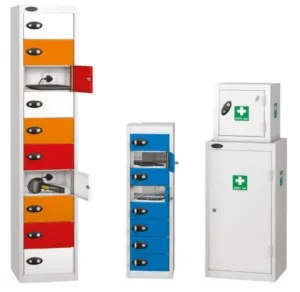
Do you need
Specialist Use Lockers ?
- Device storage/charging
- Power Tool storage/chargings
- Uniform storage
- Secure Medical storage
Some lockers are specifically designed for the use you require so make sure you look through the available range of lockers to find one which suits your needs.
If you are unsure, you can call or email us, and we can help you choose the right locker for your requirements.
Lock Selection
Factors to Consider When Choosing a Lock Type:
-
Security Requirements
Assess the value of items stored and the risk of theft.
-
User Convenience
Consider how frequently users will need to access the locker and how easy it should be to open and secure.
-
Environment
Think about the environment where the locker will be used, such as indoors, outdoors, or in a high-traffic area.
-
Budget
Evaluate the cost, not just of the lock itself, but also any potential long-term costs, like maintenance or key/card replacement.
-
Access Control Needs
Consider whether you need simple access control or more advanced features like audit trails or remote management.
Here's an overview of the different lock types available and their suitability for various needs
Cam Lock with 2 Keys
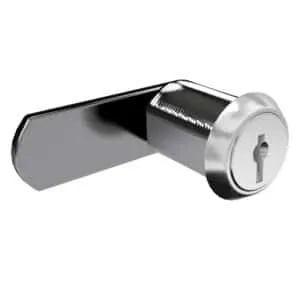
Moderate. Provides basic security, suitable for low-risk environments.
o Easy to use and install.
o Affordable and widely available.
o Replacement keys can be obtained in most cases if lost.
o Requires users to manage keys, which can be lost or stolen.
Personal use in low-security environments, such as in schools or gyms.
Hasp & Staple Lock
(For Use with Your Own Padlock)
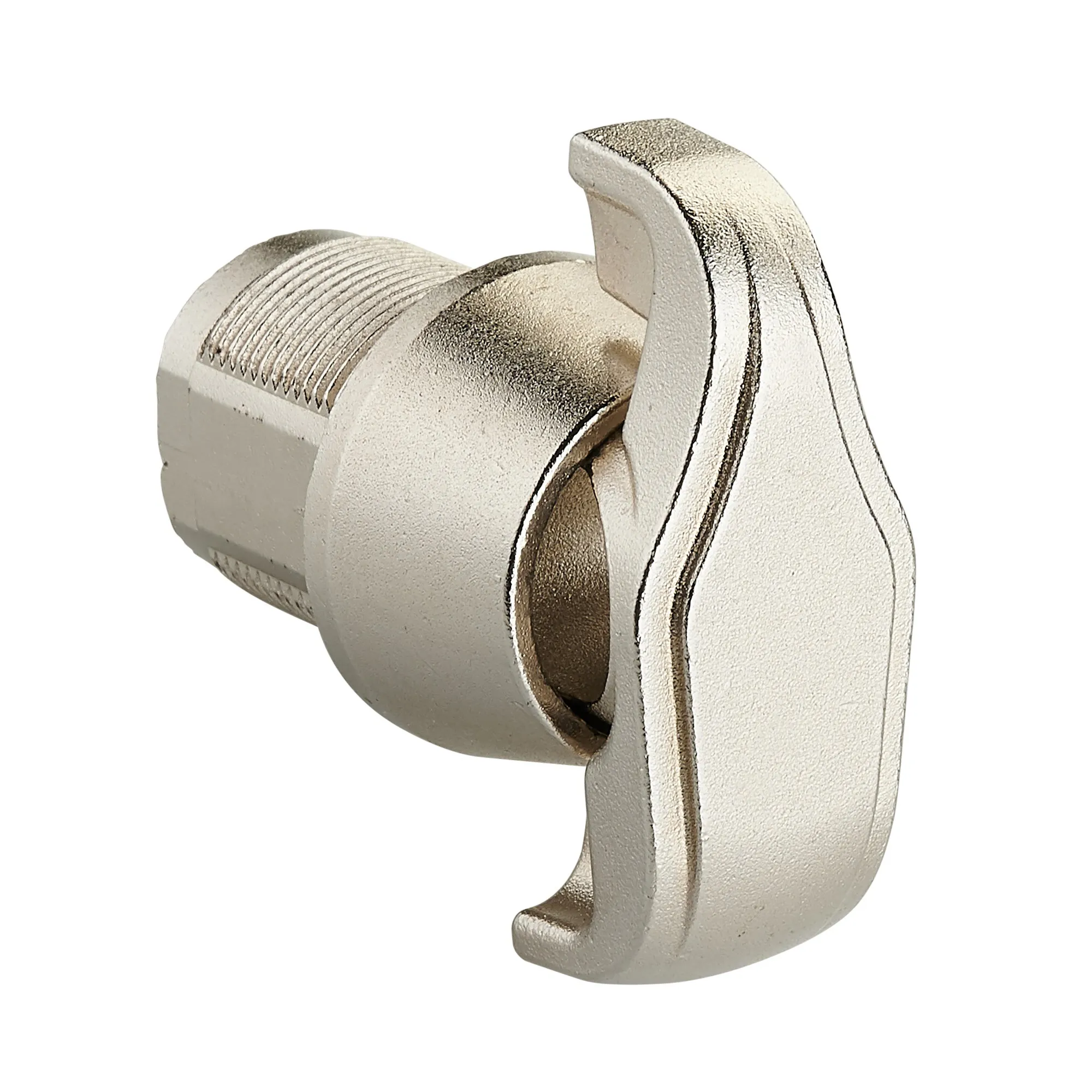
Variable, depending on the padlock used.
o Flexible, as users can choose their padlock based on security needs.
o Durable and suitable for outdoor or rugged environments.
o Ideal for shared or communal spaces.
o Security depends entirely on the padlock's quality.
o Users must bring their own lock, which may be inconvenient.
Shared or public storage areas where users prefer to use their own padlocks, such as in communal locker rooms or outdoor storage units.
Radial Pin Lock
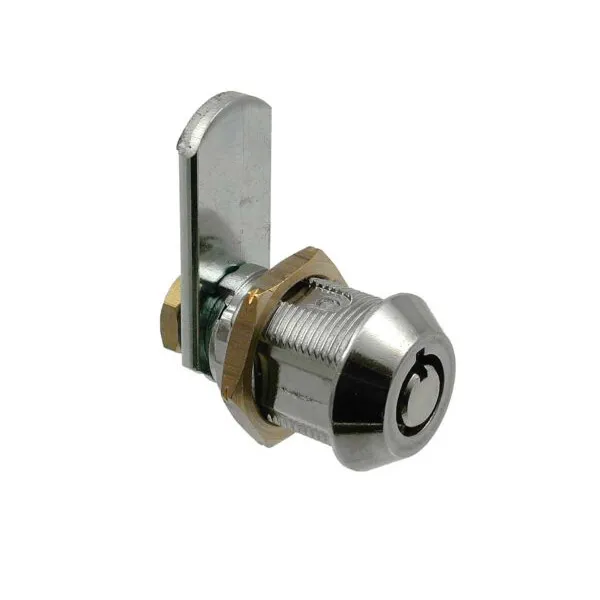
High. Harder to pick and duplicate keys for.
o High security due to complex lock mechanism.
o Compact and durable design.
o Difficult for unauthorized users to bypass.
o More expensive than basic locks.
o Lost keys can be challenging to replace.
High-security environments such as business storage units, sensitive material lockers, or high-value personal storage.
Four-Digit Mechanical Combination Lock
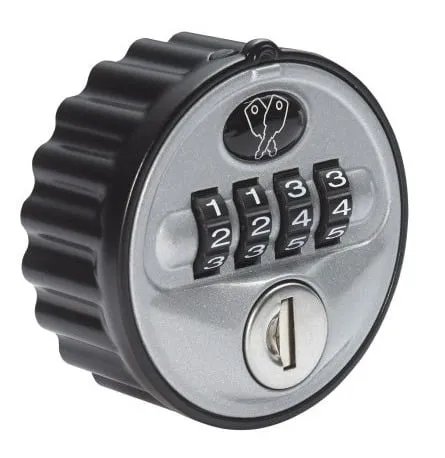
o Private Use Mode: Each user sets a personal code to access the lock.
o Public Use Mode: The first user enters a code to lock the mechanism, and the same code is required to unlock it, resetting for the next user.
Moderate. Secure against casual theft, but vulnerable to brute-force attacks (trying all combinations).
o No need for keys, reducing the risk of loss or theft.
o User-settable combinations for convenience.
o Durable with no need for batteries.
o 10,000 possible combinations.
o Requires admin intervention using code find/reset key for forgotten codes.
Situations where key management is a concern, such as in gyms, schools, or casual office settings.
Digital Combination Lock
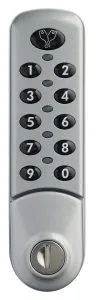
o Private Use Mode: Each user has a dedicated code to access the lock.
o Public Use Mode: Users set their own temporary code when they use the locker, which resets once the locker is opened.
High, depending on the lock’s quality and features.
o No keys needed; codes can be easily changed.
o Fully reprogrammable using a master code, allowing for easy management of user access.
o Higher security against physical attacks compared to mechanical locks.
o Requires batteries, which need replacement over time.
o Can be more expensive than mechanical locks.
High-security environments, business or corporate lockers, or situations where remote management of access is beneficial.
RFID Lock
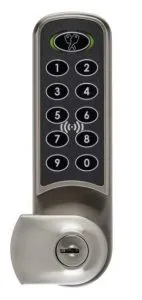
o Private Use Mode: Each user has a dedicated RFID credential to access the lock.
o Public Use Mode: The first user to tap an RFID card locks the locker, and the same card is required to unlock it, resetting for the next user.
High, depending on the lock’s quality and features.
o No keys needed; codes can be easily changed.
o Fully reprogrammable using a master code, allowing for easy management of user access.
o Higher security against physical attacks compared to mechanical locks.
o Requires batteries, which need replacement over time.
o Can be more expensive than mechanical locks.
High-security environments, business or corporate lockers, or situations where remote management of access is beneficial.
Coin Return or Coin Retain Lock
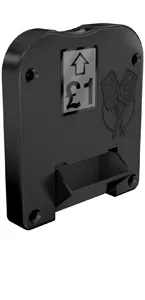
Low to Moderate. More focused on temporary or shared-use lockers.
o Ideal for temporary or shared-use lockers.
o Discourages long-term use, ensuring locker availability.
o Less convenient as users need to have coins.
o Limited security as these are generally used in low-risk environments.
Public places like swimming pools, gyms, or amusement parks where lockers are intended for short-term use.
Choosing the right lock type for a storage locker is a balance between security, convenience, and cost. For basic needs, a cam lock or a four-digit combination lock might suffice. For higher security or more advanced control, consider radial pin locks, digital combination locks, or RFID locks. For shared environments, hasp & staple locks or coin-operated locks might be the best choice. Digital combination and RFID locks offer the added flexibility of Private or Public Use Mode and are fully reprogrammable using a master code, making them ideal for environments with changing user access needs. In most cases these locks are available for both dry and wet environments.
Please check with us before ordering if you are unsure which lock you require, and our specialist team will be ready to assist you.
Delivery – We try to keep it Simple
Most of our products are delivered free of charge so the price you see advertised include delivery, all you need to do is add the VAT.
Delivery is direct from the factory and is provided as a non scheduled service. Once your order has been placed we will update you with a delivery schedule based on a week commencing date. You will receive your order within that week during normal working hours, Monday to Friday only.
Delivery is direct from the factory and is provided as a non scheduled service. Once your order has been placed we will update you with a delivery schedule based on a week commencing date. You will receive your order within that week during normal working hours, Monday to Friday only.
Please note that we are unable to provide a specific date and time for deliveries.
Most of our locker products are manufactured to order and as such the guideline delivery times for the products are detailed below. This can vary at our busiest times. Please call for current approximated product delivery times. All working days.
Express locker: 5, 10 and 15 day delivery options (subject to quantity)
Standard steel Lockers approx 10 – 20 days
Timber effect lockers 15 – 25 days
Personnel Effects Lockers 12 – 20 days
Compartment Lockers 10 – 20 days
Security lockers 10 – 20 days
High Capacity lockers 10 – 20 days
Clean and dirty locker 10 – 20 days
PPE Lockers 10 – 20 days
Wire Mesh Lockers 10 – 30 days
Lockers available as Nests 10 – 20 days
Solid Grade Laminate Door Lockers 15 – 25 days
School Lockers 10 – 20 days
Laptop Lockers 15 – 25 days
Plastic Lockers 20 – 40 days
Waterproof Lockers 15 – 25 days
Outdoor lockers 20 – 40 days
Sports lockers 10 – 20 days
Golf lockers 10 – 15 days
Slim Line Lockers 10 – 20 days
Garment dispensing lockers 10 – 20 days
Power Tool Re-Charge Lockers 15 – 25 days
Mobile Phone Storage 10 – 25 days
Cloakroom Equipment 10 – 25 days
Cupboards 10 – 20
Cabinets 10 – 20 days
Deliveries to Ireland
If your delivery is required to Ireland please call us in advance of placing any order as we have additional charges.
Please call in advance of placing an order to confirm delivery charges and to arrange payment which is based on the order value and delivery location.
Deliveries to residential Properties.
Please note the non scheduled service we provide detailed above and that we are unable to provide a specific date and time for deliveries.
If there is no one at the delivery address to receive the order we will not be able to leave the goods. If you give us confirmation to do so it must be in writing and in advance of the delivery and will also be at your own risk with Lockersonline accepting no responsibility for the security, safety and state of the products left
If we have to re-deliver due to a failed delivery
If we have been unable to deliver your ordered products and the reason for the failed delivery has not been the fault of Lockersonline then a re-delivery charge of 5% of the net value of the goods with a minimum charge of £25 will be required to be paid by the customer

Are you in need of secure and reliable locker solutions for your business or organisation? Look no further!
At Lockersonline.co.uk our expert team is here to offer top-notch locker options tailored to your unique requirements. Whether it’s for schools, gyms, offices, or any other setting, our extensive range of lockers guarantees unmatched quality and durability. From selecting the perfect locker design to seamless installation, we handle it all, ensuring a hassle-free experience for you. Don’t miss out on the opportunity to elevate your storage solutions.
Take the first step today by completing our “Request a free quote” submission form. Let us understand your needs and provide you with a personalised quote that perfectly fits your budget and timeline.
Secure your belongings with confidence – submit the form now and unlock a world of locker excellence!